Your boots do more work than any tool you own. They’re on your feet ten hours a day, on concrete, scaffolds, roofs and wet clay, and a bad pair shows up in your knees and back long before the soles wear through.
This guide explains what the safety ratings on Australian work boots actually mean, compares three of the best known Australian brands, and covers the choices that matter most: zip side or lace up, toecap material, sole and fit. It’s based on the AS/NZS 2210.3:2019 standard (via a published extract), manufacturer information and news reports, checked in October 2026. We haven’t wear-tested these boots for this version, so we don’t rank individual models.
For pants, shirts and the rest of the kit, see our workwear brands guide.
The safety rating matters more than the brand
Safety footwear in Australia and New Zealand is tested to AS/NZS 2210.3:2019, which is based on the international standard ISO 20345. Every safety category has a protective toecap that must pass a 200 joule impact test and a 15 kN compression test. On top of the toecap, each category adds features:
| Category | What it adds | Suits |
|---|---|---|
| SB | Basic safety footwear with tested toecap | Dry, low risk sites |
| S1 | Closed heel, antistatic, energy absorbing heel, fuel resistant outsole | General trade work |
| S1P | S1 plus penetration resistant midsole | Sites with nails and screws |
| S2 | S1 plus water penetration and absorption resistance | Wet conditions |
| S3 | S2 plus penetration resistant midsole and cleated outsole | Building sites, wet and rough ground |
You’ll also see extra markings for specific hazards, such as heat resistant outsoles (HRO) or slip resistance. Your employer, head contractor or site safety plan may set the minimum category, and on mine sites the rules can be stricter. WorkSafe Victoria has warned about safety footwear in mines that didn’t meet the required standard, so check the marking on the boot itself, not just the listing.
The three brands compared
All three are well known Australian work boot brands. What sets them apart is where they’re made, their history and their styling.
| Steel Blue | Redback | Blundstone | |
|---|---|---|---|
| Origin | Western Australia | Sydney | Hobart, 1870 |
| Where made | Australia and its own factory in Indonesia | Its factory in Alexandria, Sydney | Leather boots made overseas |
| Known for | Wide range of safety boots, lace up and zip side | Elastic sided pull on boots | Elastic sided boots, safety and non safety ranges |
| Safety range | Yes | Yes | Yes |
Steel Blue
Steel Blue is a Western Australian brand, founded in the 1990s, with its head office in Malaga, Perth. It says it still manufactures in Australia and also produces boots in its own factory in Indonesia. It sells through stockists rather than direct to the public. Its range covers lace ups, zip sides and pull ons in most safety categories, so it’s a common sight on building and mine sites.
Redback
Redback is best known for its elastic sided pull on boots. The company says every pair is made at its factory in Alexandria, Sydney, which makes it one of the few big work boot brands still manufacturing in Australia. Pull on boots are quick to get on and off, but they offer less ankle adjustment than a lace up.
Blundstone
Blundstone started in Hobart in 1870 and is one of Australia’s oldest footwear brands. Its leather boots are now made overseas, while the company says its gumboots are still made in Hobart. It has separate safety and non safety ranges. The classic elastic sided boot is everywhere, so check you’re buying from the safety range with an AS/NZS 2210.3 marking if your site needs it.
Browse safety boots at Workwear Hub Affiliate link. Opens the merchant site in a new tab.
Find these brands on Amazon Australia
Affiliate links (paid links). Open Amazon in a new tab. Check the listing and the boot show AS/NZS 2210.3 and a category.
Zip side, lace up or pull on
- Lace up gives the most adjustable fit and ankle support. It’s slow to get on and off.
- Zip side keeps the laced fit but adds a side zip so you can get in and out quickly. Zips can wear out or clog with mud and concrete, so check whether the zip can be replaced.
- Pull on (elastic sided) is quickest and has no laces to catch. Fit is less adjustable, and the elastic loosens over time.
Some sites ban pull on boots in favour of laced boots for ankle support, so ask before you buy.
Toecap and sole
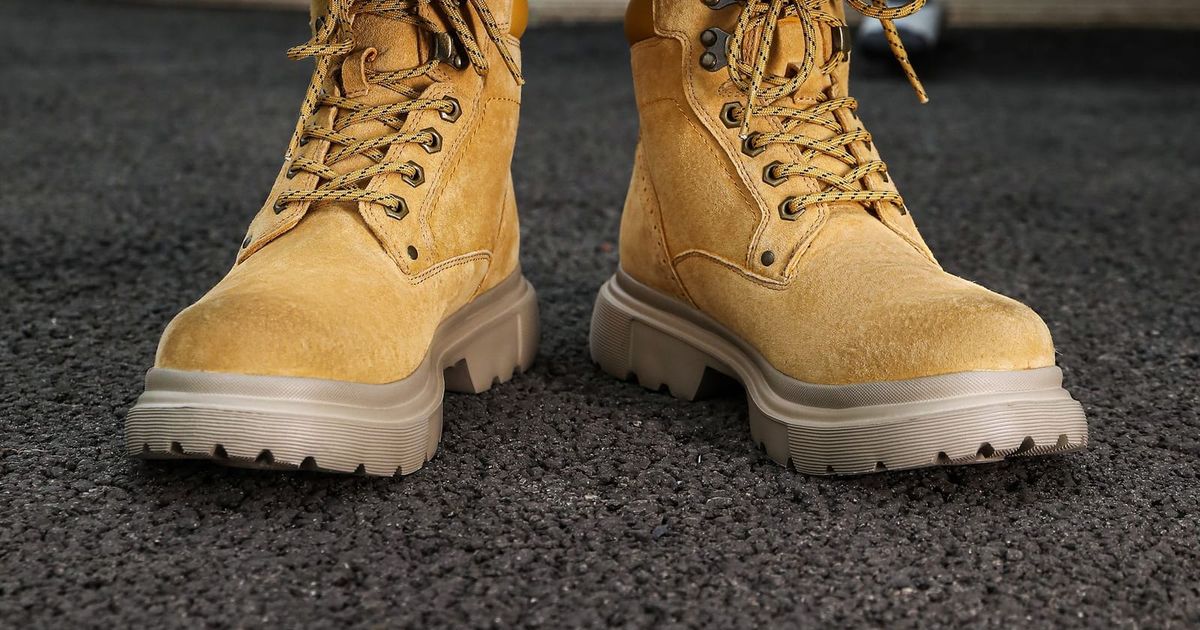
Steel toecaps are the traditional choice and are generally thinner for the same protection. Composite toecaps don’t conduct heat, cold or electricity like steel and don’t set off metal detectors, though they can be bulkier. Both must pass the same 200 joule test to meet the standard.
For soles, look at the markings. A penetration resistant midsole (S1P or S3) protects against nails and screws. A heat resistant outsole matters if you work near hot surfaces, such as roofing or asphalt. Slip resistance matters on smooth or wet floors.
Getting the fit right
- Try boots on in the afternoon, when your feet are at their largest, and wear your normal work socks.
- Your toes shouldn’t touch the toecap when you walk or crouch.
- Your heel shouldn’t lift much as you walk.
- Some brands offer wide fittings. If you have wide feet, look for them rather than going up a size.
- Expect a short break-in period for leather boots, but not pain. Pain at the toecap or heel won’t go away.
Looking after your boots
Clean off mud and concrete at the end of the day, let them dry naturally away from heaters, and treat leather now and then. Replace boots when the sole tread is worn smooth, the toecap is exposed or damaged, or the boot no longer supports your ankle. A boot that’s taken a heavy impact on the toecap should be replaced even if it looks fine.
See safety boots on Amazon Australia Affiliate link (paid link). Opens Amazon in a new tab. Check the seller and the safety rating on the listing.
Common boot buying mistakes
- Buying on looks alone. A boot that looks like a safety boot may not be rated. Check the marking.
- Going up a size for comfort. Too much room makes your foot slide and the toecap sit in the wrong place. Look for a wider fitting instead.
- Wearing one pair every day. Rotating two pairs lets each dry out properly, which helps them last and keeps your feet healthier.
Tax: boots are usually deductible
The ATO generally allows a deduction for protective footwear such as steel-capped boots used for work. Ordinary shoes aren’t deductible, even if you only wear them at work. Keep the receipt. Our sole trader setup guide covers record keeping and other common deductions.
A quick buying checklist
- Check what category your site or employer requires (S1, S1P or S3 are common).
- Look for the AS/NZS 2210.3 marking on the boot.
- Choose your style: lace up, zip side or pull on.
- Choose steel or composite toecap based on your work.
- Try them on with work socks, in the afternoon if you can.
- Keep the receipt for tax and warranty.
If you work around traffic or plant, your boots are only half the visibility picture. Our hi-vis guide explains the 2024 changes to the hi-vis standard.
Common questions
What do SB, S1 and S3 mean on safety boots?
They're categories under AS/NZS 2210.3:2019. SB is basic safety footwear with a tested toecap. S1 adds a closed heel, antistatic properties, an energy absorbing heel and a fuel resistant outsole. S1P adds a penetration resistant midsole. S2 adds water resistance to S1. S3 is S2 plus a penetration resistant midsole and a cleated outsole.
Are Blundstones made in Australia?
Blundstone was founded in Hobart in 1870. Its leather boots are now made overseas. The company says its gumboots are still made in Hobart.
Are Steel Blue boots made in Australia?
Steel Blue says it still manufactures in Australia, and that its boots are produced in both Australia and its own factory in Indonesia. Its head office is in Malaga, Western Australia.
Can I claim work boots on tax?
The ATO generally allows a deduction for protective clothing and footwear such as steel-capped boots used for work. Ordinary clothes and shoes aren't deductible. Keep the receipt and check the ATO guidance for your occupation.